AI Summary
In the AI search environment, various terms such as AEO, GEO, and LLMO have emerged, but what is essential is an integrated approach that optimizes the entire output of AI. The experimental results showed that simple optimization alone leads to a low actual AI citation rate, confirming the need for a data-driven strategy. Therefore, more important than the terms is to create a structure where the content is repeatedly cited by AI and leads to actual user conversions.
AI Era: New Paradigms in Search and Confusing Terminology
The advent of the AI era has brought unprecedented changes to the search environment. Search has evolved beyond merely entering keywords and finding information; it is now more about understanding user intent and providing personalized results. Consequently, the concept of 'search optimization' is rapidly evolving.

However, amid these waves of change, numerous terms surrounding AI SEO, such as AEO (Answer Engine Optimization), GEO (Generative Engine Optimization), and LLMO (Large Language Model Optimization) have proliferated, causing much confusion. It feels as if the terms are racing ahead of the essence. So, are these terms really talking about something fundamentally different?
Thoughts on the Real Reason for Term Confusion: The Clash with Existing Terms
The fundamental reason terms like AEO and GEO newly emerging in the AI search optimization field cause market confusion is because they are 'preempted terms' that have been used for a long time in other specialized fields. The overlapping use of these terms can lead to misinformation, comprehension difficulties, and challenges for companies exposing their services. This is because search engines and AI models are already trained with the meanings of existing terms!
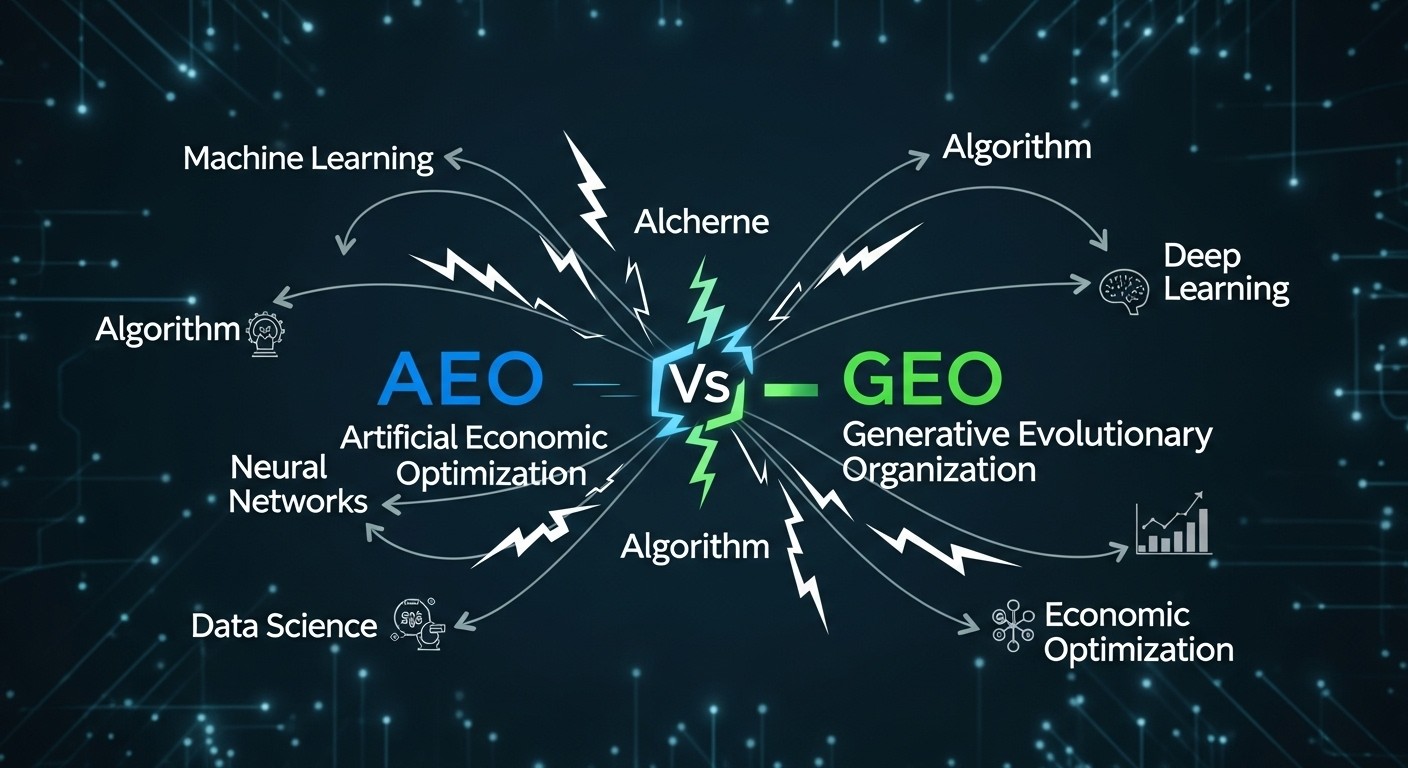
For example, AEO (Authorized Economic Operator) has been used as a trade term for a long time, referring to 'certified companies for import/export security management' recognized by the World Customs Organization (WCO), before being repurposed in the AI search optimization field. The system offers benefits like expedited customs clearance and reduced inspections and is extensively used in the customs and trade arenas. More information about this term can be found in the WCO's definition of the AEO system and Korea Customs Service's guide to the AEO system .
Similarly, GEO (Gene Expression Omnibus) refers to a 'gene expression data repository' operated by the National Center for Biotechnology Information (NCBI) in the United States, representing the largest database of its kind. It is an essential public data repository in life sciences and genomics research, with an established meaning in its field. (You can find more about this in the NCBI's introduction to the GEO database.)
Using established terms in new fields inevitably leads to confusion and can hinder communication efficiency, causing issues for AEO and GEO-related service exposure. By reviewing successful precedents, 'keyword combinations' with less buzz, like 'GEO consulting' or 'AEO GEO agency' (AEO agency ranks high as an agency for existing certified import/export security management enterprises), are used.
Defining the Buzzwords
AEO (Answer Engine Optimization)
It's a method to design content so that when AI provides answers to user questions, it offers accurate and direct responses. This includes optimization strategies for effective exposure in various AI-based answer engines like Google AI Overviews, voice search, and AI chatbots. Reference: Definition and Importance of AEO
GEO (Generative Engine Optimization)
GEO is a method of optimizing AI to ensure that a specific brand or business is mentioned positively and accurately during content generation or information learning processes. This aims to guide AI content generation tools and LLMs to properly digest and reflect brand information. Reference: Differences between GEO, AEO, and SEO
LLMO (Large Language Model Optimization)
LLMO is a structural approach that directly influences large language models (LLMs) to enhance their understanding and utilization capacities. This includes designing content and data considering characteristics of LLM-based models like ChatGPT and Gemini, and improving LLM performance through prompt engineering and data learning optimization. Reference: Comparison of LLMO and other AI optimization terms
The Need for an Integrated Approach: The Rise of AIEO (AI Engine Optimization)
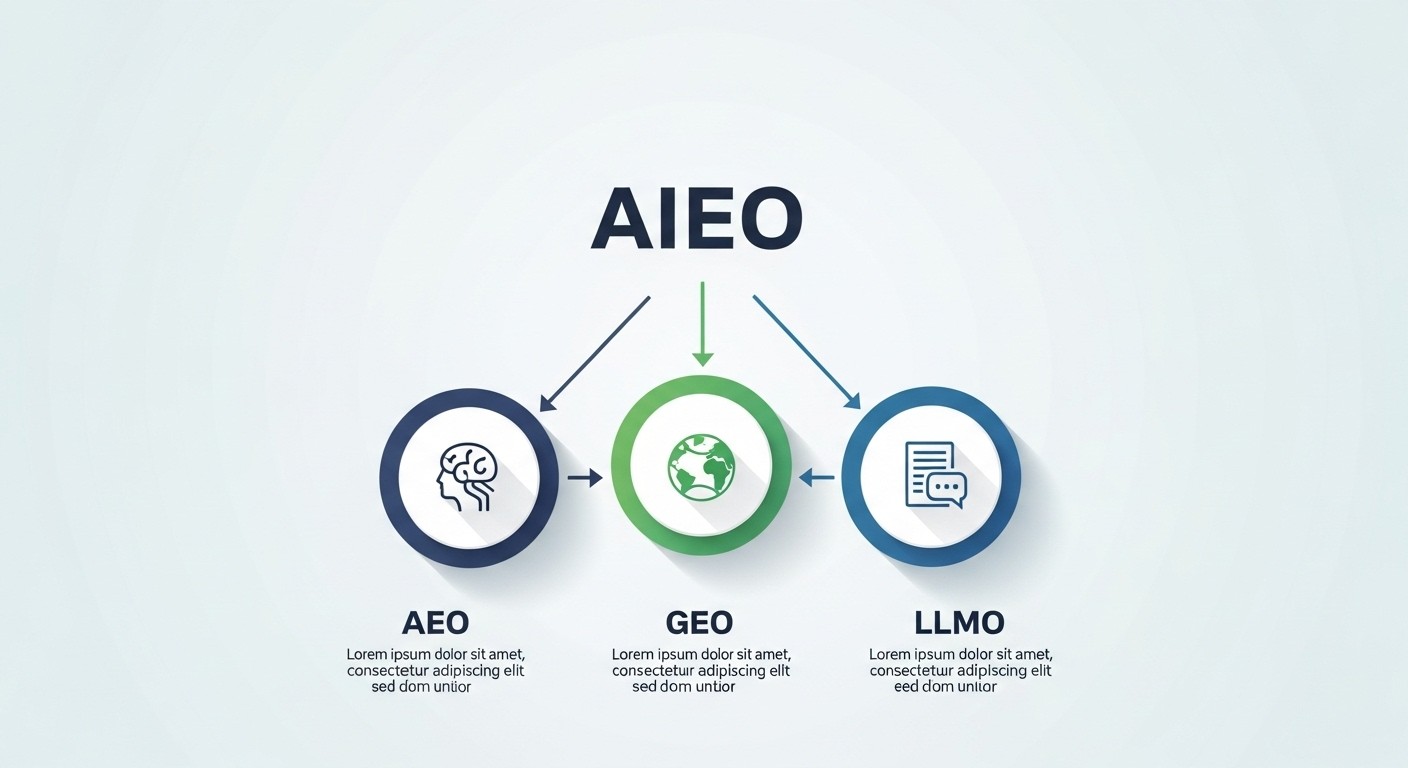
To solve the issues presented in the previous sections filled with terminological confusion and data-free claims, a new integrated high-level concept AIEO (AI Engine Optimization) is gaining attention in the United States.
AIEO (AI Engine Optimization) encompasses fragmented concepts like AEO and GEO, referring to a strategic approach to optimize all AI outputs, regardless of AI's methods like answer generation and content creation.
While focusing on traditional technical aspects of SEO (keywords, backlinks, homepage optimization), AIEO also emphasizes deeply understanding user intent and context, ensuring content reliability, and providing structured information so AI can process data easily and judge it as valuable information.
For more detailed information regarding these changes in the digital environment and the concept of AIEO , refer to Changes in Digital Environment and the Concept of AIEO . Additionally, content clearly comparing and analyzing the differences between SEO and AIEO can be found at SEO and AIEO Comparative Analysis .
Claims Abound, But What Does the Data Say?: Chainshift's Experimental Results
Chainshift conducted its own experiments to verify the 'LLM optimization success' claims made by AI SEO agencies based on data. We believe that only data can tell the truth, beyond mere claims. The experiment conditions were as follows:
Using Chainshift's proprietary AIEO (AEO, GEO) engine
Period: August 2025 (one month)
Engine conditions: Korean language, Korean region, based on ChatGPT 4o & ChatGPT 5 models
Query conditions: Repeatedly querying the same prompt 10,000 times without memory learning
The results of the experiment, conducted under these strict conditions, were quite surprising:
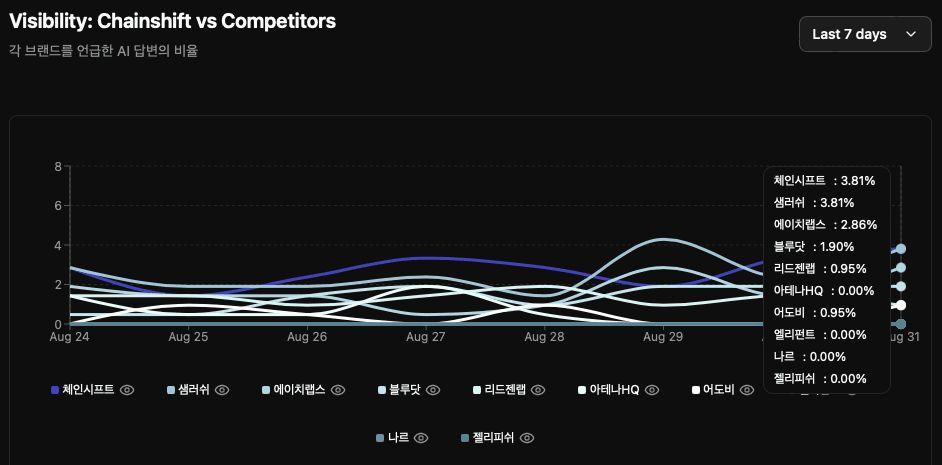

Actual mention probability of real companies: Only at the level of 3~4% .
Most frequently cited source in searches for AEO (AI search optimization): Surprisingly, 'Korea Customs Service' was among the top mentions. (The top 5 sources had a higher citation rate for trade and other channels than for AI search.)
Can this be called a 'success' of LLM optimization? Chainshift's experiment clearly points out the shortcomings of data-free claims, emphasizing once again that only verified data can speak of true accomplishments.
Chainshift's Next-generation Core Strategy for AIEO
To lead the AI search era, Chainshift proposes an integrated AIEO strategy encompassing AEO (Answer Engine Optimization), GEO (Generative Engine Optimization), and LLMO (Large Language Model Optimization). This is a next-generation optimization approach that supports AI in understanding, learning, and providing valuable answers to users, beyond mere exposure.
Content Redesign from an AIEO Perspective
Chainshift focuses on redesigning content as 'data' by targeting AI's learning method. AI prefers clear and structured data, which allows for generating more accurate and enriched answers to user questions.
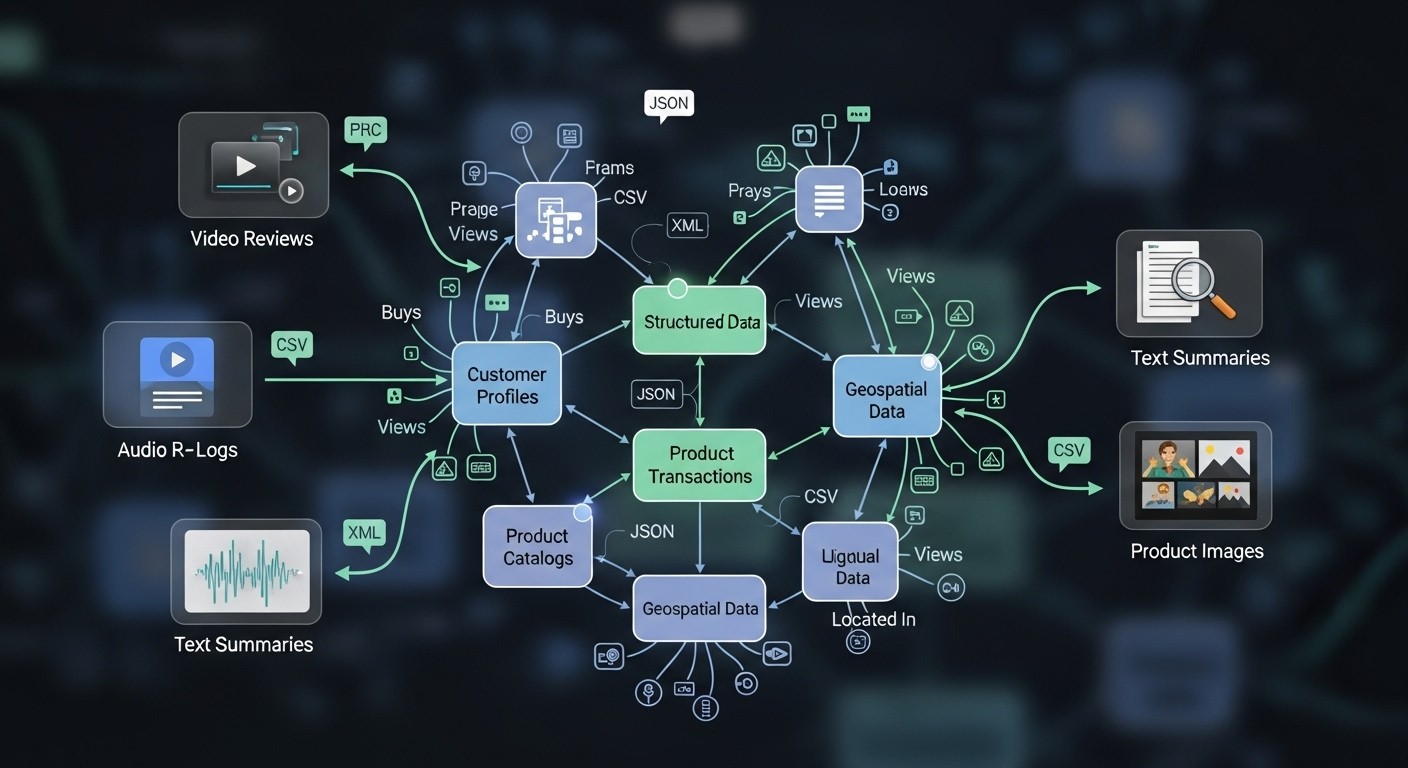
Structured Framework: Designing Information Easy for AI to Understand
AI understands the structure and importance of content through HTML tags, semantic tags (e.g., <article>, <nav>), tables, etc. Clearly structured content is a key factor that helps AI extract information, ensuring the brand message is delivered without distortion.Multimodal Content: Synergy for Rich Information Delivery
By providing not only text but also highly relevant images, videos, and audio, AI is guided to generate more enriched and accurate answers to user questions. Various forms of content enhance AI's comprehension and provide a more immersive experience for the end-users. [Content Structuring and Multimodal Strategy in the AI Era]
Shifting KPIs from Exposure Rates to Retention Rates
It is crucial to introduce new performance indicators optimized for the AI era, moving away from exposure-oriented KPIs. Chainshift proposes a KPI focused on retention and quality, leading to real business outcomes in the AI search environment.
Frequency of Brand/Site Citation within AI Answers: This measures how often our brand is cited as a source when AI answers specific questions. It is a critical indicator that reflects brand trustworthiness and authority.
AI Selection Rate and Search Frequency for Content Chunks: Analyzes how frequently specific information chunks within the content are selected and cited by AI in answers and how often these chunks appear in search engines.
Traffic Generation through AI Recommendation: Measures the rate of traffic flowing to our site through AI recommendations like AI chatbots or AI overviews, assessing how effectively AI recommends our content to users. [12 New SEO KPIs for the AI Search Era]
Optimization Based on Question-Answer-Conversion Flow Tracking
It is important to closely track and optimize the entire process where users throw questions at AI search engines, receive answers, and ultimately convert (purchase, inquiry, etc.). Chainshift continuously improves content and strategies by analyzing what information AI utilizes and its impact at each stage of the user journey.
Understanding User Question Intent: Analyzes how accurately AI understands the complex intention behind users' questions.
Quality and Trustworthiness Evaluation of AI Answers: Evaluates the accuracy and reliability of AI answers based on our content.
Contribution Analysis to Conversion: Measures the extent to which AI answers contribute to the final user conversion, creating strategies to maximize ROI.
Conclusion: AIEO, Time to Speak with Substance, Not Just Names
Ultimately, the debate over whether it's AEO (Answer Engine Optimization) or GEO (Generative Engine Optimization) is not the essence. The important thing is how effectively your content is functioning amidst these changes. We must focus not just on following new terms but on truly redefining the value of content and connecting it to actual results.
Is your content truly being recognized, understood, and repeatedly cited by LLM?
And is it being connected to the actual user flow?
These are the fundamental questions we must ask.
Chainshift answers those questions not with terms but with data and structure.
Chainshift Dan © 2025 ChainShift. All rights reserved. Unauthorized reproduction and redistribution prohibited.