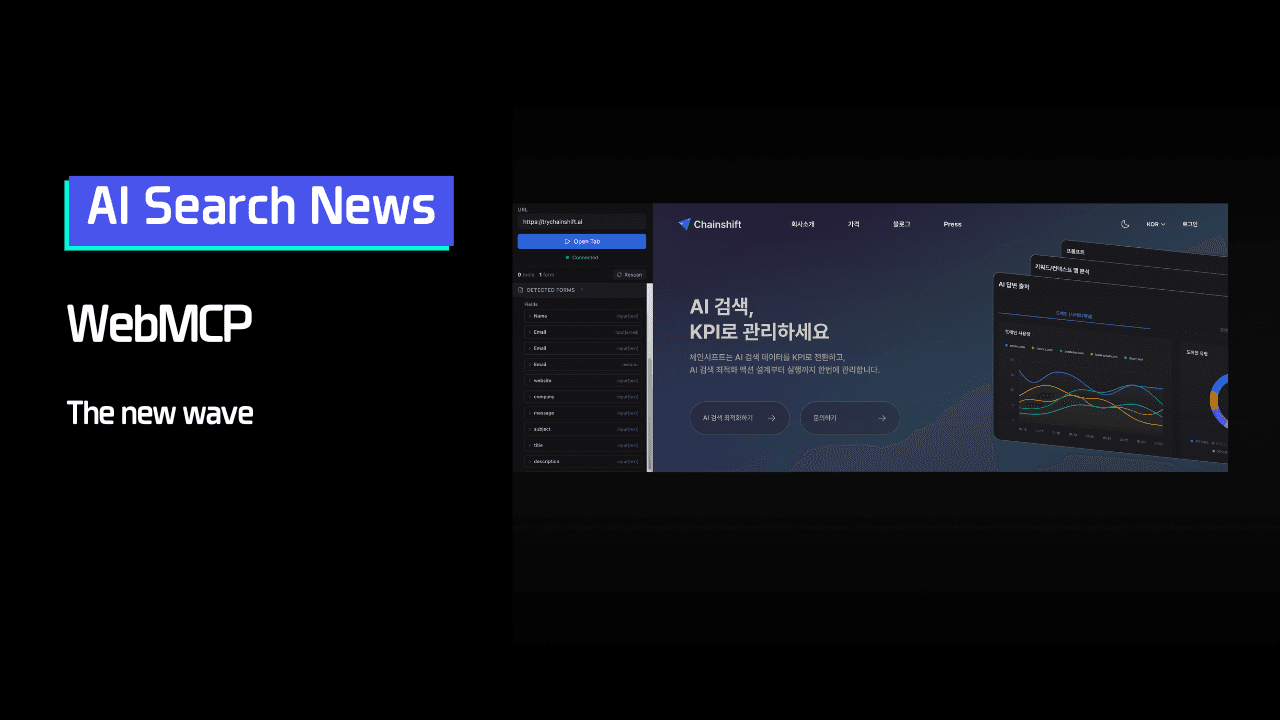
AI Summary
1. The current web is an inefficient system because its DOM-based structure forces AI to operate through “guesswork” rather than true “understanding.” 2. WebMCP bypasses the DOM and transforms the web into a function-based interface, shifting it to a structure that AI can execute directly. 3. Future competitiveness will depend not on visibility, but on an “executable web structure” that AI can actually use.
Right now, AI agents cannot properly “use” the web.
Like travelers wandering a foreign city without a map, they capture screens, forcibly parse HTML, and guess what buttons mean. And even a small UI change breaks the entire behavior. It is slow, expensive, and above all, structurally unstable.
It is easy to think this problem is simply because “AI is not good enough yet,” but there is actually a more fundamental reason.
It is that the structure of the web itself was not designed for AI.
The DOM was originally an interface for humans
So far, the web has evolved around the DOM (Document Object Model).
The DOM is a structure built on the premise of human interactions such as clicking, scrolling, and typing. In other words, it is an “interface for display.”
But for AI, the DOM has a completely different meaning.
It cannot tell what a button does, cannot understand what data an input field requires, and is not clear about what function a form performs. In the end, AI has to guess everything. It analyzes the HTML structure, assumes the role of elements, simulates clicks and inputs, and retries when it fails.
This process is not just inefficient. It is a structurally flawed approach.
Because the DOM is about “presentation,” not “meaning.”
Limits of the DOM-based web: cost, instability, and absence of meaning
The problems created by this structure can be summarized in three points.
First, cost.
The process of parsing the DOM, capturing screens, and repeatedly trying dramatically increases token and compute costs. Work that could be solved with one API call is split into dozens of steps.
Second, instability.
If a class name changes or the DOM structure is modified even slightly, the entire logic collapses. A UI redesign directly means a collapse in AI usability.
Third, absence of meaning.
The DOM can “display” something like <div class="btn-primary">Search</div>, but it does not contain the fact that this is a function called “search(query).”
What AI needs is structured function calling. But the DOM does not provide that information.
WebMCP: not parsing the DOM better, but bypassing it entirely
This is where the concept of WebMCP (Web Model Context Protocol) appears.
The core of WebMCP is simple.
It is not about understanding the DOM better, but making it unnecessary to go through the DOM itself.
If previously AI had to read, interpret, and infer from the DOM, in a WebMCP environment the website directly says this:
“This is a function called searchFlights, and if you enter origin, destination, and date, I’ll return results.”
AI no longer looks for buttons or attempts clicks.
It just calls a function and receives the result.
Dozens of interactions are replaced by a single call.

An image comparing how AI agents operate before and after adopting WebMCP
The role of the web is changing: from pages to functions
This change is not a simple technical update, but a shift that changes the very definition of the web.
In the past, the web was pages.
Then it evolved to be content-centric.
And now, the web is being redefined as function.
What matters is no longer “how well it is displayed.”
It is how well it executes.
The SSR vs frontend debate needs a completely different question
At this point, a natural question arises.
“Does this mean the age of frontend is coming back?”
But this question itself is the wrong frame.
It is not a return to CSR, and it is not that SSR is ending.
The real change happens one level above that.
Now the web is divided into three layers.
HTML for humans (SSR/SSG)
Structured content for search engines (SEO/AEO)
Execution interface for AI (WebMCP)
The DOM is still necessary.
But this is no longer a web centered only on the interface; this is the point where rendered output designed with AI in mind becomes equally important.
Changes marketers and product teams must understand
This change directly affects marketing strategy as well.
Many teams still think, “If we create a lot of content, we’ll get AI exposure.”
But AI does not simply read content.
It chooses based on whether it can use it.
Now GEO strategy evolves beyond being cited, into entering AI workflows.
For example, think of a travel service:
In the past, “recommended destination content” mattered,
but going forward, AI will choose sites with structures that let it execute booking immediately.
So what should we do now?
What is needed to respond to this change is clear.
First, the DOM must be cleaned up.
Removing unnecessary structure and having semantic HTML with clear form structures becomes a prerequisite for WebMCP.
Second, core actions must be defined.
Functions such as search, booking, purchase, and consultation should be divided not by “pages” but by “function” units.
Third, the UI must be reinterpreted as functionality.
Buttons are function calls, forms are input schemas, and result pages are responses.
Fourth, KPIs must change.
Not impressions and clicks, but AI execution rate and task completion rate become the key metrics.
Conclusion: the DOM is not over, its role has changed
For the past 30 years, the DOM has been the center of the web.
But in the AI era, the DOM is no longer the interface.
It is simply a rendering layer for humans to view.
WebMCP is an attempt to turn the web back into an interface.
Except this time, it is not an interface for humans
but an interface AI can directly use.
And now the most important question is this.
Is your website
not whether AI can “read” it,
but whether AI can “use” it
Reference
https://developer.chrome.com/blog/webmcp-epp?hl=ko
https://news.hada.io/topic?id=26597
Chainshift Daniel
© 2026 ChainShift. All rights reserved. Unauthorized reproduction and redistribution prohibited.