AI Summary
Since the ACP, AI has evolved from simple recommendations to a 'purchase execution system' that handles cart composition and payment requests. The key to competition in commerce has shifted from corporate partnerships to structured product data (product feed), where the quality of the data that AI reads determines success or failure. Marketing criteria have also transitioned from citation (GEO) to 'selection', and it is expected that the ability of AI to actually select products will become a core competitive advantage.
AI now executes 'purchase' rather than just 'recommendation'.
Yesterday, OpenAI reintroduced the ACP (Agentic Commerce Protocol), which cannot be seen as merely a functional update. Many people understand it as an “AI shopping feature” or “commerce integration,” but in reality, it is a change that fundamentally alters the structure of search and commerce. To summarize this change in one sentence: AI is transitioning from being a system that generates answers to a system that executes purchases.
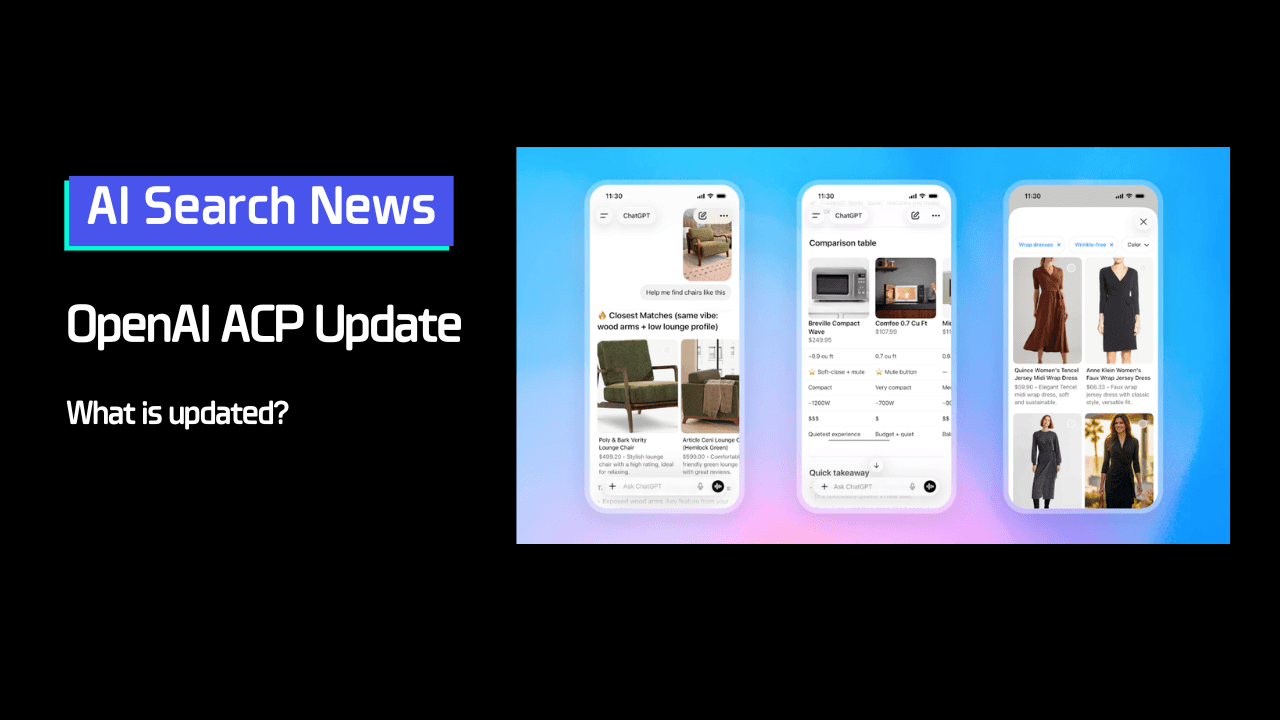
While existing AI could recommend products, it was unable to facilitate actual transactions. The reason is clear: there was no real-time commerce data, such as price, inventory, shipping, and payment. As a result, the role of AI always stopped at “recommendation.” However, the structure has completely changed since ACP. Product data is provided directly in the form of product feeds, prices and inventory are reflected in real-time, and payments are processed in a delegated form through PSP. In other words, ChatGPT has evolved into a purchasing agent that selects products, configures orders, and even makes payment requests, rather than simply serving as an information provider.
The unit of partnership becomes 'data' rather than 'company'.
A key point noted by many people in this change is the expansion of partnerships with providers like Shopify. However, there is a more fundamental change at play. Now, partnerships are established not through contracts but through data uploads. In the past, one had to enter into a contract with a specific platform and undertake complex integrations, but with ACP, merely aligning with standardized product feeds connects directly to the AI commerce ecosystem. In other words, the unit of partnership has shifted from companies to data. This is the most crucial structural change of this update.
This structural change is also reflected in the user experience. Traditional commerce involved stages of searching, clicking, comparing, adding to cart, and payment. However, post-ACP, when a question is asked, AI recommends products, compares them, constructs the cart, and then only leaves payment as the remaining step. The important point here is that now the cart is created not by humans, but by AI. Looking at the actual checkout structure, all products, delivery options, and prices are finalized, leaving only payment remaining. Thus, it can be said that most of the purchasing decision-making has already been completed by AI.
An era of 'choice' rather than 'exposure', and...
This change alters the very benchmarks of marketing. Previously, SEO was about how much exposure one had, and GEO was about how often one was cited in AI responses. However, after ACP, the questions change. Whether AI adds your product to the cart or not becomes the core issue. In other words, it has shifted from exposure or citation to a matter of choice.
At this point, what is important is not content but data. In the ACP environment, AI does not crawl and understand web pages; instead, it understands and compares products based on structured product feeds. The attributes of products, the structure of descriptions, the configuration of options, the freshness of prices and inventory—all of these become input values for the recommendation algorithm. This is an entirely different realm compared to keywords or backlinks in SEO. Now, brands will compete not through web pages but through datasets that AI can read.
Following this trend, the next stage is naturally defined. SEO has transitioned to GEO, and we are entering the stage of Agent Commerce Optimization. In the past, it was important to appear in AI responses; now, what matters is whether one is chosen as an actual purchase candidate. This is the flow proceeding from Visibility to Citation, and now to Selection.
Ultimately, the core of this ACP update is not technology but structure. It is not that AI has become smarter; rather, it is that the supply chain and data have been connected so that AI can actually choose and execute. And this change will completely shift the competitive landscape moving forward. It is no longer about who gets the most exposure, nor who gets cited the most, but who is selected by AI that matters. A new era is commencing.
Now, the question is straightforward: Is your product ready to be added to AI's cart?
Reference
https://openai.com/index/powering-product-discovery-in-chatgpt/
https://developers.openai.com/commerce
https://developers.openai.com/commerce/guides/get-started
https://developers.openai.com/commerce/guides/best-practices
https://www.agenticcommerce.dev/
Chainshift Daniel
© 2026 ChainShift. All rights reserved. Unauthorized reproduction and redistribution prohibited.