AI Summary
The AI shopping system is evolving through Google's A2A intent-based multi-agent approach and OpenAI's search-based personalization method. OpenAI enhances personalized recommendations by utilizing memory engines and user data, and there is a possibility that it may surpass the existing search-centric structure in the future. As a result, AI shopping is expected to shift away from SEO focus and place data-driven personalization and connectivity structures as core competitive factors.
AI-based shopping recommendation systems are rapidly evolving with technological advancements.
In particular, Google's Agent-to-Agent (A2A) protocol and OpenAI's Agentic Commerce Protocol (ACP) protocol provide crucial insights into how AI shopping agents work.
Google's A2A recommends products based on the user's intent. Multiple agents interact with each other based on the user's intent, resulting in product recommendations.
In contrast, OpenAI's ACP, similar to a traditional search, first searches for products and then provides recommendations based on those results. While this approach is not significantly different from Perplexity Shopping, which launched late last year, OpenAI is expected to collect personalized data in the future to provide even more personalized recommendations. In other words, while recommendations previously relied on simple search results, personalized recommendations based on user ID will now be possible.
Experience with AI Shopping Research
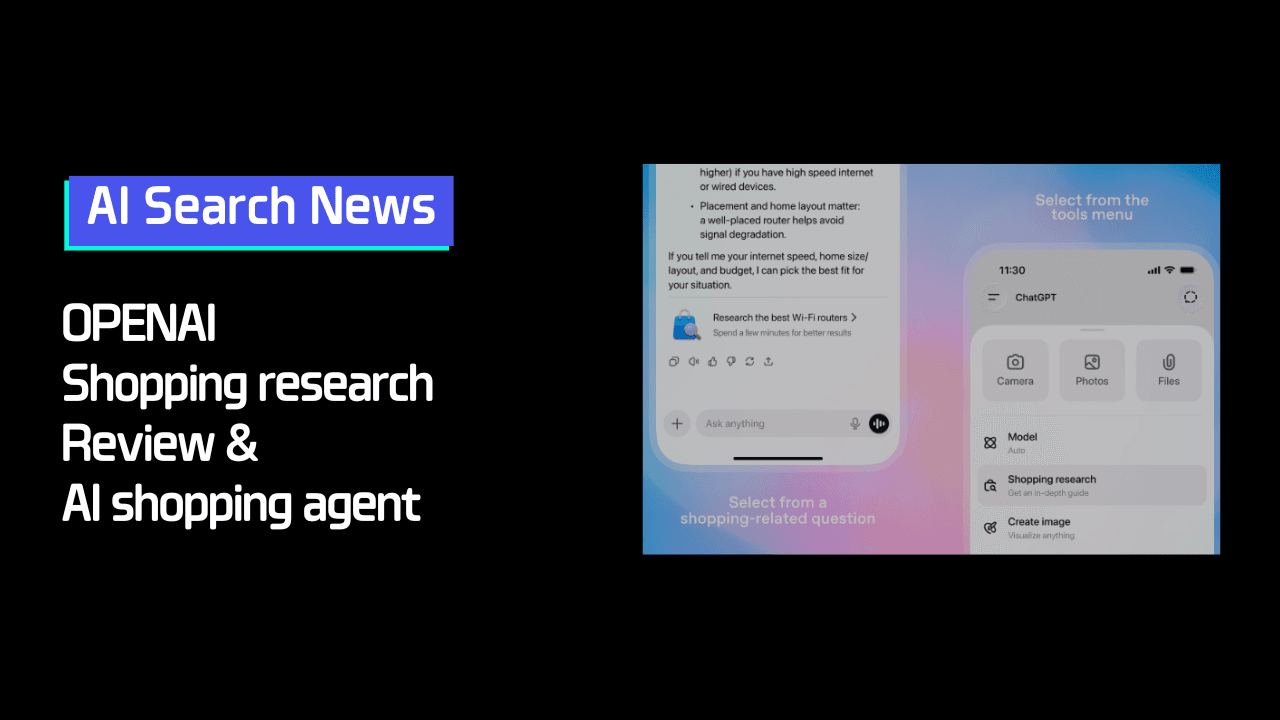
After using OpenAI's newly released AI Shopping Research feature, we found that recommended products received over 100 citations, significantly more than standard chat.
However, compared to existing shopping UXs, the time-consuming search process, like Deep Research, was a point of contention.
Nevertheless, it appears that differentiated effects can be expected in recommending high-involvement products.
Learn about OpenAI Shopping Research
OpenAI's Shopping Assistant is a conversational model that utilizes a conversation tree structure to manage each message in a tree-like structure. This structure is extremely useful for reconstructing the context of each conversation step.
In fact, OpenAI utilizes a memory engine that stores and analyzes user chat information. This information includes occupation, interests, past requests, and preferred styles, enabling personalized shopping recommendations.
Based on this collected personalized data, the Shopping Research Assistant classifies user requests, extracts desired attributes, and recommends optimal products based on these attributes. This information is presented in the form of a quiz within the UI, providing a more intuitive user experience.
For example, if a user requests "Recommend a skin lotion for men in their 30s," the system will ask multi-select questions about budget, style, and features to recommend the optimal product. Furthermore, a safety layer automatically filters out inappropriate requests, increasing system reliability.
Next, products are explored through the Shopping Search tool. Structured Search and Semantic Search are combined to search for products, and review analysis is used to determine the recommended score.
Google A2A vs. OpenAI ACP: Differences in Data and Recommendation Systems
Based on what we've discussed so far, let's compare the Google and OpenAI shopping agents again.
Google A2A focuses on the multi-step process of product recommendation and payment, where multiple agents interact based on intent. Google's vast data base facilitates information exchange between various agents.
In contrast, OpenAI, with its relatively limited personalized data, directly collects price and intent data based on user ID and provides personalized recommendations based on this data. This may be inspired by Perplexity, which first introduced its AI Shopping Research feature late last year. At the time, Perplexity attracted significant attention for its pioneering AI shopping initiative and 0% commission fees, but ultimately failed to achieve success in AI shopping.
In other words, OpenAI appears poised to address the need for functionality beyond simple AI shopping search with personalization.
💡 Conclusion: The Future of AI Shopping
OpenAI's Shopping Research will rapidly evolve into a system that provides personalized recommendations based on price and intent data.
As personalization factors intensify and AI shopping agents rely on independent judgment, the importance of traditional SEO-based exposure optimization methods is likely to diminish.
Furthermore, as AI shopping agents directly manage personalized data, new KPIs will emerge that go beyond existing SEO, AEO, and GEO systems. Ultimately, connectivity and optimization layers like AI Shopping Connect will become key, and content optimization and data integration will become increasingly important.
Concerns about the AI Shopping Ecosystem: How Can Google and OpenAI, With Gateways, Become Platforms?
While AI Shopping Research Tools or AI Shopping Agents will be central to product recommendations, brands and businesses (merchants) will play a crucial role in providing data.
Furthermore, if a platform's AI agent prioritizes specific brands, businesses that do not advertise may be disadvantaged. Therefore, if LLM companies create advertising products specifically for specific businesses, this could raise concerns about the reliability and fairness of the AI Shopping Agent.
AI-based shopping requires consideration of how to collect brand and business data, what criteria are used to rank this data, and what the final formatter is, to optimize the process from personalized recommendation systems to purchase conversion. ChainShift will closely monitor this process and serve as a partner to Merchant Agents.
Building a fair and reliable recommendation system through AI Shopping Research, and further collaboration between AI Shopping Agents and Merchant Agents, is key to creating a sustainable AI shopping ecosystem. ChainShift will lead the way.
Chainshift Daniel © 2025 ChainShift. All rights reserved. Unauthorized reproduction and redistribution prohibited.