AI Summary
TF-IDF is a method that determines the importance of a word in a document based on how frequently it appears in that document compared to others. It calculates the core keywords by multiplying TF and IDF, taking into account both the ‘rarity and frequency’ of the words. This method is utilized as a fundamental technology for extracting important words in search engines, document classification, chatbots, and more.
Is “apple” really an important word?
When reading a document, we quickly grasp the gist of the text by looking at the title or the first sentence. Computers do something similar: they look at words to determine what a document is about. However, not all words are equally important.
For example, in the sentence “I want to eat a banana,” the word “banana” feels more important than words like “I” or “want,” right?
There’s a technology that helps computers understand this too. That’s TF-IDF.
🍌 In simple terms, TF-IDF is a “word importance calculator.”
TF-IDF stands for Term Frequency - Inverse Document Frequency. It sounds complicated, but here's a simple explanation:
“Words that appear frequently, but only in this document, are the most important!”
If a word appears multiple times in a document → It is considered important in that document
But if that word appears in multiple documents? → It's just a common word and not considered important
🍎 Learning TF, DF, and IDF with examples
▶ TF (Term Frequency)
This looks at how many times a word appears in a document.
Document Content
Document 1 I want to eat an apple.
Document 2 I want to eat a banana.
Here, “eat” appears once in both documents, right?
“Banana” only appears in Document 2. Therefore, “banana” could be a more important word in Document 2.
▶ DF (Document Frequency)
This measures how many documents a word appears in.
“Eat” appears in both Document 1 and Document 2, so DF = 2.
“Banana” only appears in Document 2, so DF = 1.
▶ IDF (Inverse Document Frequency)
IDF is the opposite of DF!
Words that appear in many documents are common, so they are less important.
Words that appear in only a few documents are rare, so they are more important!
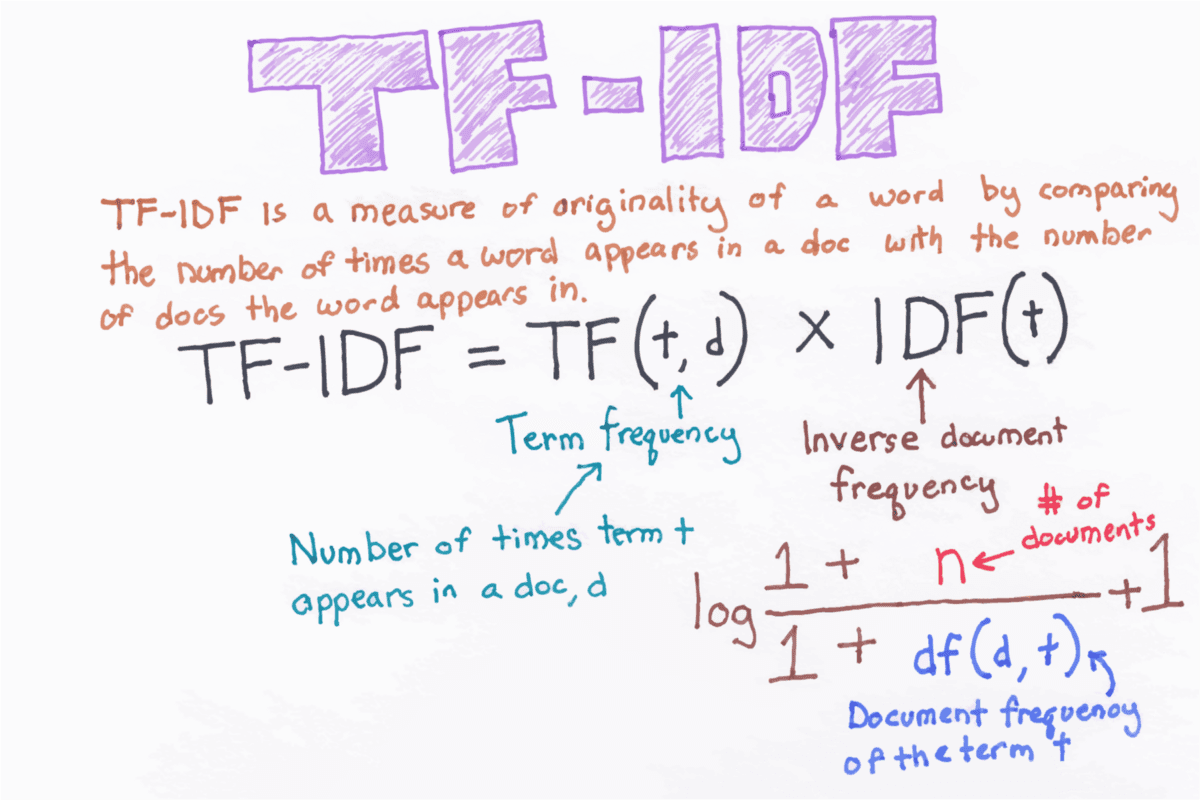
The IDF formula looks like this, but don't worry too much. We just need to interpret it.
IDF(t) = log(total number of documents / (number of documents containing the word + 1))
For example, if there are 4 documents in total and “apple” appears in only 1 document:
IDF = log(4 / (1 + 1)) = log(2) ≈ 0.693
🍇 So what is TF-IDF?
Now we're all set.
TF × IDF = TF-IDF
In other words, we multiply how often a word appears in a document (TF) by how rare the word is (IDF)
to find the truly “important words.”
🥝 Real-world example: Is banana really important?
The table below shows the number of times each word appears in each document (TF). (This is also called DTM.)
Document 1
Banana: 0
Eat: 1Document 2
Banana: 1
Eat: 1Document 3
Banana: 2
Eat: 1
Now, let's calculate TF-IDF by multiplying the IDF values.
In Document 2, “banana” appears once, so TF = 1.
In Document 3, it appears twice, so TF = 2.
Let's assume that IDF is 0.287682 in both cases.
So:
Document 2: 1 × 0.287682 = 0.287682
Document 3: 2 × 0.287682 = 0.575364
Even if it's the same word, Document 3, where it appears more often, is considered more “important”!
🤖 Where is TF-IDF used?
Search engines: When you search for “I want to eat an apple,” documents with high TF-IDF scores are displayed first.
Document classification: When distinguishing whether a document is a “sports article” or “entertainment news”
Chatbots: When extracting important keywords from user questions
And it's no exaggeration to say that almost all the basics AI uses to understand text these days start with TF-IDF.
🚀 In conclusion: TF-IDF is a technology that assigns scores to words!
You may feel like you've seen too much information, but just remember one thing.
TF-IDF is a technology that tells you “how special this word is” in numbers.
When analyzing documents or building AI models in the future, using TF-IDF can enable smarter analysis.
Now, we’re one step closer to creating AI that can “read” documents through TF-IDF!
💡 Preview of Next Content
“What’s Next After TF-IDF?” — Methods for Calculating Document Similarity
“Building Your Own Search Engine: Let’s Start with TF-IDF!”
“Beyond TF-IDF… How Does BERT, a Deep Learning-Based Model, Understand Words?”
ChainShift Roy
Reference: https://wikidocs.net/31698
© 2025 ChainShift. All rights reserved. Unauthorized reproduction and redistribution prohibited.