AI Summary
The search paradigm is shifting from link-based SEO to GEO centered on 'mentions' in AI responses, as the competitive criterion for brands is changing from clicks to memory. Since LLM reconstructs information based on user questions, the key is not just exposure but being repeatedly cited within context. Ultimately, the goal of marketing is no longer just to rank high in searches, but to have AI remember the brand and include it in responses.
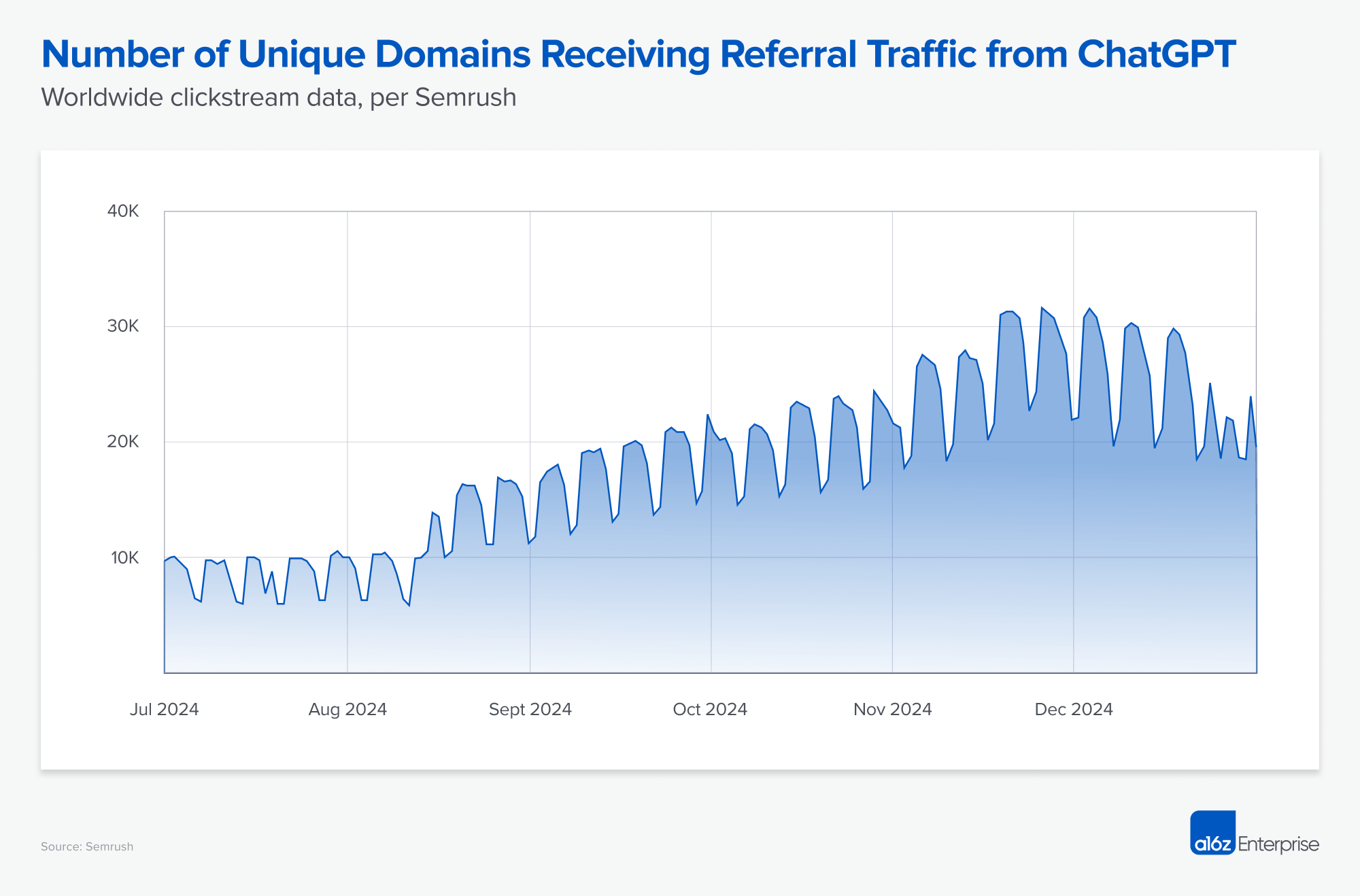
Number of Unique Domains Receiving Referral Traffic From ChatGPT
Source: Worldwide clickstream data, per Semrush
In the age of GPT answers, if you are not remembered, you do not exist.
Since the 2000s, search has been synonymous with Google. When it came to search optimization, SEO was the only answer, and keyword-centric content, backlink building, and domain authority scores were at the heart of every strategy. However, by 2025, search is increasingly shifting away from browsers and toward generative language models (LLMs).
Especially after Apple announced that it would integrate AI-based search features like Perplexity and Claude into its Safari browser, cracks began to appear in Google's dominant search distribution system. The foundation of the traditional SEO market, which had dominated the industry for over 20 years (with an annual scale of approximately $80 billion), began to shake. Now, search is no longer based on page rankings but on mentions (references) within language models. This new order is called GEO (Generative Engine Optimization).
From links to language models… the center of search is shifting.
Traditional search was built on a structure of links. Users entered keywords, and algorithms analyzed backlinks, content depth, UX signals, and other factors to display results in a “ranking.” In contrast, today's search is based on conversational interfaces like ChatGPT, Claude, and Gemini, and users now acquire information directly from the answers themselves, rather than through link clicks.
Search queries have grown longer (average 23 words), sessions have become deeper (average over 6 minutes), and users are demanding context-based information. Additionally, LLMs remember past inputs in memory to reflect personalization, integrate multiple sources, and generate context-appropriate customized answers. In this process, “which brand is cited” has become the standard for information reliability.
GEO is a competition of “references” rather than “clicks”
While click-through rate (CTR) was previously the standard for performance, reference rate is now the key metric. How frequently, in what context, and in response to what questions your brand appears in A's answers has become a critical indicator.
To address this, GEO tools that support brand mention tracking, contextual analysis, model source identification, and sentiment analysis within LLM responses are rapidly emerging in the market. For example, tools like Profound, ChainShift, Goodie, and Daydream simulate brand-related prompts, visualize mention patterns, and analyze competitors' AI search market share.
Canada Goose used a GEO tool to analyze not only how often ChatGPT recognized its brand in terms of functions like “cold” or “waterproof,” but also whether it ‘remembered’ the brand itself. This is a representative example of using “brand spontaneous recall rate (Reference Rate)” as a marketing strategy metric, indicating whether AI recalls the brand on its own without users searching for it.
LLM does not follow links; it creates memories.
While SEO is link-based, GEO is “memory-based.” AI regenerates contextually appropriate information from the data it has learned. To be mentioned here, it is not enough for content to simply be exposed; it must have a structure and brand presence that can be remembered by the model. Therefore, the following strategies are emerging for GEO optimization:
Summary phrases (e.g., “In summary”) or bullet formats help the model extract information more effectively.
Content with high semantic density is more advantageous than simply filling in keywords.
Since LLMs operate on a subscription model rather than ad revenue, the motivation for citing third-party content is different.
The content cited by the model provider must add “value” to the user experience.
GEO is not just an analysis tool, but a new marketing infrastructure.
GEO does not stop at analyzing how often a brand is mentioned. The essence of GEO is to “influence the model.”
In the future, GEO platforms are likely to evolve in the following directions:
Self-learning prompt data and fine-tuning models
Real-time content generation and optimization tailored to AI
Predicting user flows through similar clickstream data
Acting as an “ERP system for AI marketing” that tracks interactions between brands and models
This goes beyond simply securing visibility, becoming a core channel for brand strategies that design relationships with AI. While SEO designed “touchpoints with users,” GEO designs “touchpoints with models.” In other words, it's about making AI remember you.
GEO is now a new frontier in the advertising ecosystem, and we are already seeing its potential to shake up the entire advertising ecosystem.
Just as AdWords did in the 2000s and Facebook ad targeting did in the 2010s, 2025 will be the era of GEO, a competition to enter the AI model.
In the past, SEO strategies were adjusted according to changes in Google's algorithms, but now model updates from GPT or Claude are transforming entire marketing strategies.
GEO is not merely about “optimization.” It is a competition that shapes the future of brands by designing the very way AI remembers.
Does AI remember your brand?
Marketers' questions have evolved as follows:
“Are we showing up in search results?” → “Does AI remember our brand?”
The era of search is coming to an end. Now, GEO—the “competition of memory”—has begun.
To secure a spot on the first screen of AI interfaces, you must start your GEO strategy immediately.
Author: ChainShift Anna
Reference: https://a16z.com/geo-over-seo/?utm_source=social&utm_medium=li&utm_campaign=enterprise
© 2025 ChainShift. All rights reserved. Unauthorized reproduction and redistribution prohibited.