AI Summary
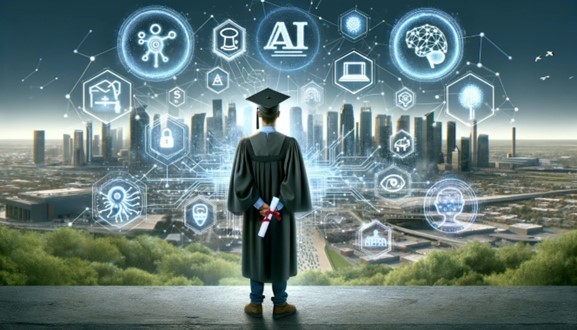
AI is replacing learning and task execution, shaking the very reason for the existence of universities and the essence of education. However, since AI cannot create the purpose of questions and ethical judgments on its own, the cultivation of human culture and critical thinking becomes increasingly important. Ultimately, education in the age of AI must be redefined not as the delivery of knowledge, but as fostering meaningful questions and the ability to make judgments.
Is AI a tool or a subject?
Technology evolves every day, but the questions in our lives remain valid.
In an era where AI has become deeply embedded in our daily lives, how can we coexist and grow with this tool?
Chainshift goes beyond simply being a company that creates technology; we ponder what meaning technology should have for humans.
In this content, we will explore the impact of AI on the space of “university” and the values we must not lose in the process.
AI studies, and students watch TikTok. Then why does the university exist?
COVID-19, ideological turmoil, and now AI. The third “earthquake” facing universities worldwide is neither physical nor political. It is technology. And that technology is shaking the very foundation of why universities exist, even as we speak.
According to a recent column in New York Magazine, just two months after the release of OpenAI's ChatGPT, nearly 90% of American college students reported having used AI to complete assignments. It is estimated that this number has only increased since then. This is not merely for reference purposes. AI is being used for tasks such as organizing class notes, generating practice problems, writing essays, analyzing data, and even solving coding assignments. A student at NYU confessed:
“I know I'm not learning anything.”
Students are increasingly becoming dependent on AI, and educational institutions are unable to stop it. Instead of implementing a unified policy on AI use, universities are effectively shirking responsibility by leaving it up to professors' discretion. Some professors are even using ChatGPT to create assignments and grade answers. In short, humans are disappearing, and classrooms are becoming places where machines converse with machines.
🤖 AI may be smarter than humans, but it is not human
AI optimists say,
“AI will become a ‘superintelligence’ that will lead humanity to prosperity.”
However, the definition of that prosperity is vague. What kind of “prosperity” will come about by destroying human purpose, autonomy, and the value of meaningful labor?
In reality, AI still cannot match humans in the ability to ask good questions. Even economist Tyler Cowen admits, “AI still cannot ask questions as good as the ones I ask.” This is not merely a technical issue. Good questions stem from good purposes.
A student said they used ChatGPT to save study time and instead spent that time watching more TikTok. Her question, “How can I spend more time on social media?” shows how the misuse of technology for the wrong purpose can lead to undesirable outcomes.
📚 Technology is just a tool, but who determines the purpose of that tool?
In fact, a true liberal arts education is necessary to use AI effectively. Without experience reflecting on good and evil, truth and justice, beauty, and training in philosophical thinking, one cannot judge the results produced by AI. However, the content AI models are currently learning from is heavily skewed toward social media conversations (50%), web pages, Wikipedia, news, etc. (37%), with book-based learning accounting for a mere 13%. Moreover, the quality of these books varies greatly.
AI lacks the lived experiences and communal memories that humans have. While it can match numerical data, it can never replicate intuition, insight, or ethical judgment. This is because the human brain is shaped by the context of life, whereas AI exists solely as numerical data within algorithms.
🏛️ Will the final bastion of ‘education’ crumble?
Cowen and AI researcher Avital Balwit argue that humanity must find a “compromise to maintain humanity” alongside AI. However, their outlook, like Marx's utopia, is likely to clash with reality and disintegrate. While acknowledging that AI will destroy human autonomy and meaning, they rely on the vague belief that “it will all work out in the end.”
But true liberal arts education does not speak that way. Classical philosopher John Henry Newman defined the purpose of education as follows:
“To cultivate the ability to make intuitively fair judgments about everything we encounter.”
Such education is the only path that can help humanity remain human in the AI era.
🎓 What should universities be for?
If universities want to survive today, they must offer a vision that goes beyond being a “degree mill.” Beyond simple technical education, there is an urgent need for liberal arts education that encourages students to ask themselves what kind of life is meaningful. And that education is the last line of defense against unconditionally entrusting human energy to AI.
If universities abandon their mission to preserve, inherit, and disseminate the wisdom and knowledge accumulated by humanity, who will take on that role?
If we entrust human memory to AI, the future will be built not on memory but on forgetfulness.
Author: Chainshift PG
Reference: https://unherd.com/2025/06/will-the-university-survive-ai/?us=
© 2025 ChainShift. All rights reserved. Unauthorized reproduction and redistribution prohibited.