AI Summary
In the AI search environment, the spread of zero-click searches has greatly diminished the effectiveness of traditional SEO-based traffic strategies. Accordingly, AEO (Answer Engine Optimization) aims to be cited in AI responses, emerging as a core strategy that achieves a significantly higher conversion rate compared to before. Ultimately, marketing is shifting away from being exposure-centric to becoming a trusted information source that AI relies on and utilizes.
The End of Search and the Beginning of New Opportunities in the AI Era
Have you heard the chilling warning of the "traffic apocalypse?" HubSpot, which coined and spearheaded the term "inbound marketing," effectively predicted the end of inbound marketing in its "Inbound2025" campaign. With the introduction of Google's "AI Overviews" and the acceleration of "zero-click search," traditional methods of driving website traffic are coming to an end. The phenomenon of click-through rates for first-time organic links dropping by a staggering 79% is no longer a distant memory. In an era where AI can answer every question, where should our content go?
But within this crisis lies a new opportunity: "Answer Engine Optimization (AEO). AEO goes beyond simply driving clicks; it's a key strategy that establishes our content as a "trusted source of information" for AI. We must now enter a new era of marketing, one where our information is cited in answers directly provided by AI.
The Problem: SEO's Limitations
The limitations of traditional SEO strategies stem from fundamental changes in today's search landscape. In particular, Google's introduction of AI Overviews has revolutionized the user experience, significantly reducing the need to click through to websites. AI Overviews provide direct, summarized answers to users' questions at the top of search results pages, eliminating the need for users to navigate to websites for information.
This shift is accelerating the phenomenon of Zero-Click Searches. Statistics show that click-through rates (CTRs) for first-line organic links have dropped by up to 79% as users find all the information they need on search results pages. ( Full Impact Analysis of Google AI Overview by Industry , Organic Traffic Decrease and SEO Adaptation Tips Due to Google AI Overviews See) This goes beyond simply reducing traffic; it also means that the value of top search engine rankings, which traditional SEO relied on, is no longer as strong as it once was. As a result, previously successful SEO strategies are now reaching their limits, unable to effectively respond to changes in search intent and user behavior.

The Real Reason Why AEO Matters: The Secret to Overwhelming Conversion Rates
AEO (AI Search Engine Optimization) is more than just simple search engine optimization. Beyond that, it provides the value of real "conversion rates" necessary for business growth. In the era of AI search, "quality" is far more important than quantity of traffic, and users acquired through AI search are high-quality prospects who are already close to making a purchase decision. They trust the information curated by AI and visit to find specific solutions, so they have a much higher conversion rate than regular search traffic.
According to Ahrefs analysis, AI search traffic has a whopping 23x higher conversion rate than traditional organic search traffic. This clearly demonstrates how important quality is over quantity. [Ahrefs' own analysis: AI Search Traffic Conversion Rate Study]
Semrush research reports that AI search visitors are 4.4 times more valuable than traditional organic search visitors. This means that AI-driven user acquisition goes beyond simply increasing numbers; it leads to tangible business results. [Semrush's AI Search and SEO Traffic Value Study]
Forbes' study is even more striking. E-commerce sites using AI-powered conversational search have achieved a 9x higher conversion rate compared to general keyword searches. This suggests that users are already exploring information while close to making a purchase decision. [Forbes Study: LLM-Based Searches Have 9x Higher Conversion Rates]
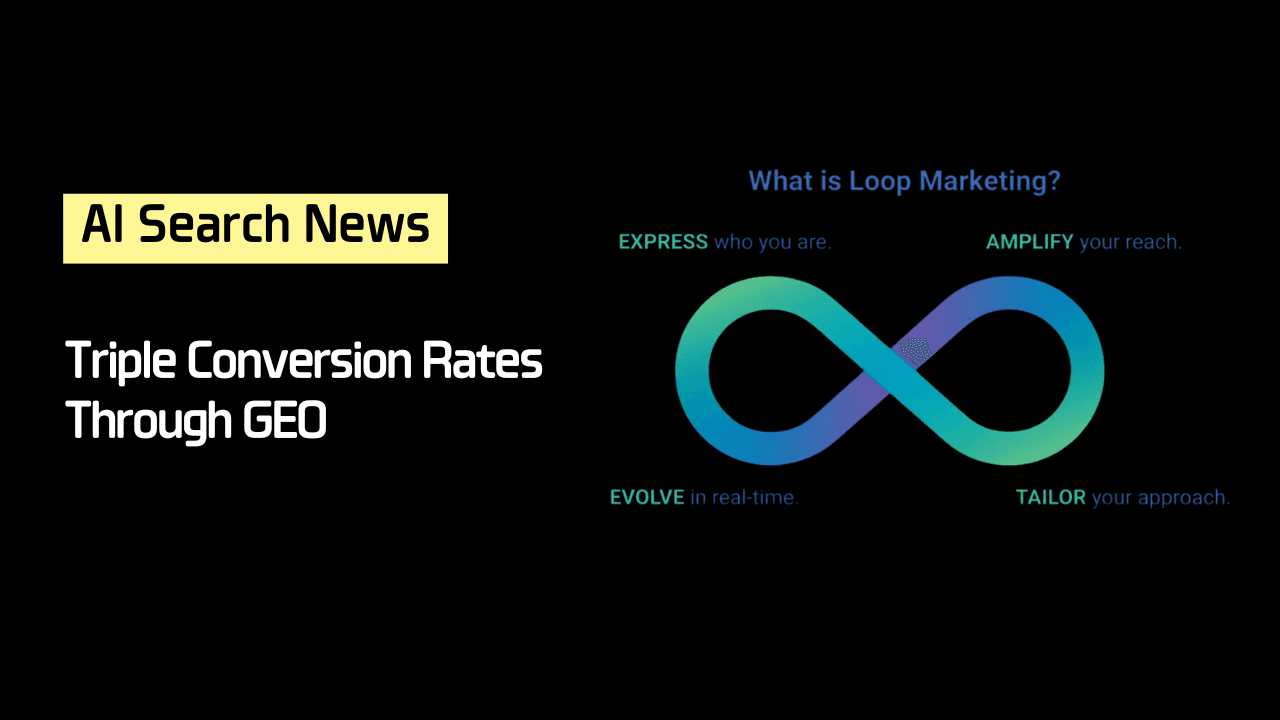
Global marketing solutions company HubSpot also demonstrated the powerful ROI of AEO by announcing that leads acquired through AEO strategies have a 3x higher conversion rate than traditional inbound leads. [Introducing HubSpot's AI-Era Growth Playbook, 'The Loop']
As such, AEO is a key strategy that provides a growth engine for your business by not only increasing exposure, but also attracting high-quality leads and achieving impressive conversion rates. Now is the time to realize a powerful ROI by implementing AEO.
A New Paradigm: Beyond SEO to AEO (Answer Engine Optimization)
Marketing strategies are constantly evolving in the new digital environment. The emergence of AI-powered search, in particular, is highlighting the importance of AEO (Answer Engine Optimization), a new paradigm that goes beyond traditional SEO (Search Engine Optimization) strategies. AEO aims to optimize our content so that it's cited as a trusted "source of information" when answer engines like ChatGPT and Google AI Overviews provide direct answers to user questions. This goes beyond simply ranking high on search engine results pages (SERPs) to becoming a core part of AI-generated answers. This shift builds on research showing that AI search traffic has up to 23x higher conversion rates than traditional organic search traffic, and AI search visitors are 4.4x more valuable. Open Ads , Divine Reference) further emphasizes its importance. We hope the following comparison table will help you clearly understand the essential differences between SEO and AEO and help you develop an effective marketing strategy in the coming era of AI.
Features | SEO (Search Engine Optimization) | AEO (Answer Engine Optimization) |
|---|---|---|
Goal | To 'expose' the website at the top of the search engine results page (SERP) | To be cited as a 'source of information' for AI answers and contribute directly to the answers |
Core Strategy | Keyword optimization, backlink building, technical SEO, improved user experience (UX), and improved content quality | Providing clear and concise answers, FAQs, and Q&A-style content, structured data (Schema Markup), reliable source citations, AI-friendly content design |
Key Metrics | Search Ranking, Organic Traffic, Click-Through Rate (CTR), Page Duration | Citation Frequency in AI Answers, Contribution to Answer Completeness, Conversion Rate through AI Search (e.g., 23x Higher Conversion Rate, 4.4x Higher Value) |
The Role of AI | Assist in Sorting and Ranking Search Results, Understanding User Intent | Understands Questions, Extracts and Summarizes Relevant Information, and Generates and Provides Direct Answers to Users |
4 Actionable Strategies for a Successful AEO
Optimizing AI Search with Structured Content
AI search engines prefer content that provides direct and clear answers to users' questions. Therefore, when creating content, it's important to structure it so that AI can easily understand the information and generate answers. In particular, actively utilize question-and-answer (Q&A) formats and frequently asked questions (FAQ) sections to provide useful information to both readers and AI. This greatly helps AI accurately understand the core message of the content and reflect it in search results.
Building Content Authority by Strengthening Credibility and Expertise
AI search engines place a high value on the accuracy and reliability of information. Therefore, to enhance the expertise and authority of your content, you must clearly cite verified data and reliable sources. By presenting objective evidence, such as research results, statistics, and expert quotations, and by providing detailed sources, you can enhance the credibility of your content. This is a key strategy that increases the likelihood that AI will recognize the information as an authoritative answer and provide it to users.
Improving Search Engine Understanding with Schema Markup
Schema markup is structured data that helps search engines more accurately understand the context and meaning of your content. Using schema markup appropriate for your content type—whether it's a product, service, event, FAQ, or review—allows search engines to clearly categorize information and provide users with rich search results (rich snippets). This increases the likelihood that AI will understand your content more deeply and use it to answer relevant questions.
Build Brand Trust with Channel Diversification
AI models learn about your brand's credibility and expertise through consistent information across various channels. By conveying consistent messages and values across various channels, such as blogs, social media, videos, podcasts, and newsletters, you can build brand awareness and authority in AI models. For example, HubSpot has successfully increased its brand visibility in the AI-powered search era by expanding its content channels to include podcasts, newsletters, and more. This channel diversification strategy ensures that AI recognizes your brand as a trusted source of information on specific topics.
Essential Tools for Executing an AEO Strategy: HubSpot AI
To effectively execute the AEO (AI Search Optimization) strategy described above, powerful tools are essential. HubSpot offers innovative AI-powered tools to help brands optimize their content and gain visibility in the AI-powered search environment. In particular, the 'AI Content Assistant' and 'AEO Grader' are two key pillars of this AEO strategy.
AI Content Assistant
HubSpot's AI Content Assistant is a powerful tool for creating AEO-optimized content. This assistant helps you quickly generate blog ideas, write clear outlines, and draft content specifically for AI search engines, reducing content creation time and improving quality. This allows marketers to efficiently produce high-quality content tailored to the characteristics of AI search engines. Learn more about HubSpot's various generative AI marketing tools.
AEO Grader
AEO Grader is a key tool for analyzing your brand's visibility and perception across leading AI platforms (GPT-4o, Perplexity, etc.) to measure the effectiveness of your AEO strategy and suggest areas for improvement. This tool provides an in-depth analysis of how your brand is mentioned and perceived on AI platforms. It also identifies the strengths and weaknesses of your current AEO strategy through visibility comparisons with competitors and sentiment analysis. This allows marketers to accurately understand their brand's position in the AI search landscape and make data-driven strategic improvements to achieve greater visibility. Learn more about HubSpot AEO Grader.
Conclusion: Turning Crisis into Opportunity: Sustainable Growth through the Collaboration of AI and Humans
So far, we've seen that the transition from SEO to AEO is not simply a technological advancement; it's a fundamental shift in the marketing paradigm. The complexity of the search environment and rising user expectations no longer require simple keyword optimization alone. A new approach optimized for an AI-driven, answer-driven search environment is needed.
Ultimately, the success of an AEO strategy depends on the collaboration of a "hybrid team" that organically combines human creative strategy with AI's efficient execution. This collaboration allows brands to build unwavering authority in a changing environment and ultimately sustainable growth . AEO is a key to future marketing, transforming crises into opportunities to usher in a new era.
Chainshift Hana © 2025 ChainShift. All rights reserved. Unauthorized reproduction and redistribution prohibited.